DC Comics — Character Profile
Hans von Hammer
The Hammer of Hell
DC Comics — Character Profile
The Hammer of Hell
Origins
Hans von Hammer is a German World War I fighter ace, one of the most lethal pilots in the skies above the Western Front. Feared by Allied forces who call him "The Hammer of Hell," he is a man of rigid honor in a world of chaos.
Created by writer Robert Kanigher and artist Joe Kubert in 1965, Enemy Ace debuted in Showcase #57. His design broke new ground: a war hero who fought for the enemy. Von Hammer was never a villain, never a caricature, but a deeply tragic figure trapped by duty and talent.
He fights because he is extraordinarily good at it. Not because he enjoys it. The distinction haunts him.
Code of Honor
Von Hammer fights by a strict personal code. He will not attack a downed enemy. He will not fire on a non-combatant. He will not lie. This code does not make him weak, it makes him terrifying, because within it he is utterly merciless.
He is both celebrated and isolated by his skill. German high command decorates him; his fellow pilots keep their distance, half in awe, half in fear. His only true companion is a wolf that finds him in the Black Forest, as if recognizing something elemental.
Each man I kill is a piece of myself I lose. But I cannot stop. The skies demand more of me still.
— Hans von HammerThey call him the Hammer of Hell, the most feared ace in the Kaiser's air force. His enemies pray they never meet him. His allies pray he's on their side.
— Robert Kanigher, narrationMechanical Companions of the Sky
For Hans von Hammer, the sky is a lonely, brutal place, and his aircraft are his only true companions. Throughout his fictional combat career, his choice of machinery reflects his status as an outsider. He consistently chooses to paint his planes a striking, singular crimson, deliberately eschewing standard military camouflage to signal his presence to his adversaries — ensuring they know exactly who they are fighting in the "heaven" of combat.
This was the definitive, iconic vehicle for the "Hammer of Hell" during the classic Silver Age stories. The three stacked canvas wings gave von Hammer unmatched maneuvering and climbing capabilities in dogfights. To create this legendary aircraft, Joe Kubert brilliantly synthesized real-world aviation history: he borrowed the striking, solid-crimson livery of Manfred von Richthofen (The Red Baron), but juxtaposed it by painting a stylized face — featuring eyes, eyebrows, and a mustache — directly onto the engine cowling. This face motif was a direct homage to the personal aircraft of Germany's brilliant 48-victory ace Werner Voss, who famously painted a nearly identical face on his pre-production Fokker F.I.
In the Enemy Ace narrative, this combination strips the aircraft of standard military camouflage, signaling von Hammer's terrifying presence to his adversaries while adding an eerie, lifelike persona to his mechanical companion.
Featured in Enemy Ace: War in Heaven #1 (2001). As an aging man dragged back into the cockpit to protect young flyers, this all-metal monoplane represented von Hammer's agonizing compromise: flying for the Luftwaffe while deeply despising the Third Reich. His aircraft is a Bf 109F-4 or early G-variant. Real-world Luftwaffe doctrine required theater-specific tactical markings — specifically, bright yellow fuselage bands and yellow under-wing tips — so German ground anti-aircraft batteries could easily identify friendly planes in the chaotic, low-altitude dogfights of the Eastern Front.
Artist Chris Weston meticulously honors realistic WWII aviation details. He layers von Hammer's custom crimson paint over a standard Luftwaffe splinter camouflage pattern, leaving the yellow Eastern Front theater bands fully visible on the nose and wingtips. Most notably, Weston features the historic unit emblem of Jagdgeschwader 51 (JG 51 'Mölders') — the black bird silhouette flying upward inside a yellow circular crest — directly on the engine cowling, a brilliant historical homage to real-world ace Werner Mölders. Furthermore, by categorically refusing to allow the Hakenkreuz to be painted onto the tail fin, his plane becomes a historical paradox: it wears the colors of the German state, but completely strips away the markings of the political party running it.
Featured in the tragic conclusion of War in Heaven #2 (2001). The screaming jet engines and terrifying speed of the world's first operational jet fighter symbolized the dawn of total, mechanized, industrial warfare — completely detaching the pilot from the old-world chivalry von Hammer desperately clung to. By 1945, Germany was completely running out of raw materials, high-grade fuel, and specialized aircraft paint. Late-war Me 262 jet fighters were often rushed out of hidden forest factories with incredibly rough, experimental camouflage patterns featuring patchy, mottled greens and grays designed to hide the jets on the ground from Allied strafing runs.
For the finale, von Hammer's jet is painted a much darker, muted solid oxblood/scarlet red, entirely dropping the vibrant crimson of his youth. Weston renders the aircraft with zero gloss or sheen — it looks hand-painted, heavily weathered, soot-stained from the primitive Jumo 004 jet engines, and thoroughly battered. The shift from a vibrant, pristine red triplane in 1917 to a filthy, dull-red jet in 1945 visually mirrors von Hammer's soul. It is no longer a proud, chivalric statement of an aristocrat inviting a duel; it is the grim, desperate camouflage of an old ghost trying to survive a mechanical nightmare.
Uniforms, Medals, and the Red Baron Influence
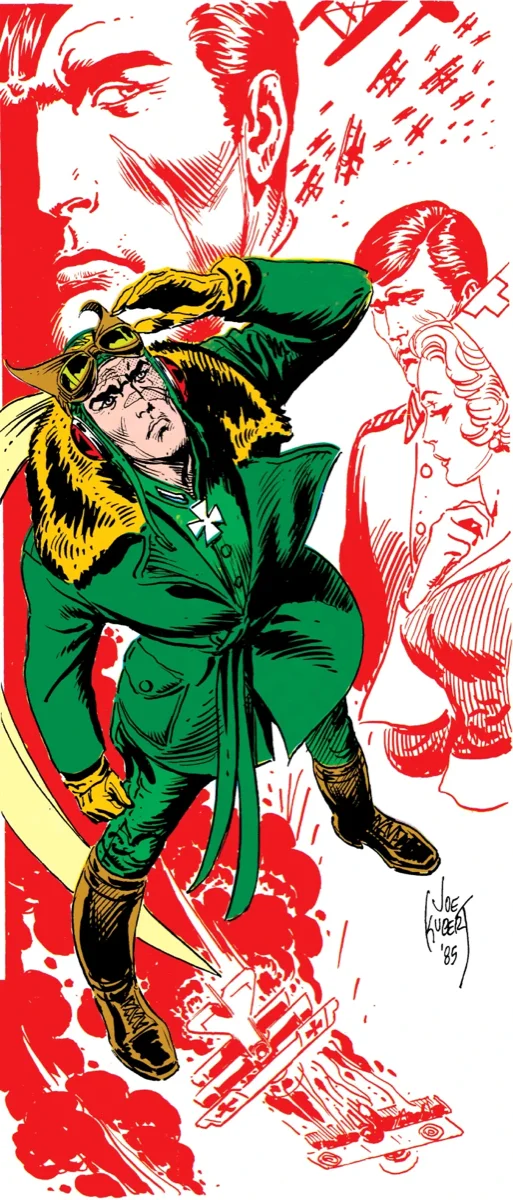
Robert Kanigher and Joe Kubert meticulously based Hans von Hammer's physical appearance, military attire, decorations, and grim habit of collecting silver victory trophies on the real-world "Red Baron," Manfred von Richthofen. Mirroring Richthofen's exact aristocratic rank, von Hammer carries the military title of Rittmeister—a traditional German cavalry rank meaning "Riding Master" or Captain of the Cavalry. Because the early imperial air services grew directly out of traditional horse-mounted regiments, this title signifies his elite status as a noble, mounted officer of the clouds. This heritage is visually anchored directly onto his leather flying hat by the prominent golden eagle crest. In the Imperial German military, officers routinely unbolted these metallic eagle plates—known as a Wappen—from their formal, spiked Pickelhaube dress helmets and custom-stitched them directly onto their soft leather aviation headgear. His uniform was not merely a costume; it is a suit of armor that binds him to a strict, archaic code of military aristocracy.
It is this profound, isolating code that shapes his relationship with the wilderness around him. Kanigher made a brilliant psychological deviation from the historical text regarding the Baron's famous animal companion. While Richthofen went to war alongside a massive, beloved Great Dane named Moritz, the comic strip swaps this domestic dog for a wild, solitary Black Forest wolf. Acting as the ultimate visual metaphor for the Rittmeister's profound isolation, this untamable beast serves as his only true confidant—a kindred creature of the wilderness who mirrors von Hammer's own existence as a lethal, solitary hunter feared by his fellow men.
Like Richthofen, Joe Kubert dressed von Hammer in an identical double-breasted, high-collared cavalry dress uniform of a Prussian lancer. This choice visually emphasizes that von Hammer is fundamentally a displaced 19th-century knight forced into a 20th-century machine, completely detached from the mud-bound trench warfare below.
Imperial Germany's highest military order for gallantry sits prominently suspended from his collar neck ribbon. Von Hammer wears the Blue Max identically to Richthofen. In the text, the medal acts as a gilded psychological shackle. It represents the tragic paradox of his existence: the more he hates the killing, the more his country rewards him with heavy, shining metal. It is a physical manifestation of his curse, proving his lethal efficiency to a world that celebrates his trauma.
Kanigher used these medals to highlight von Hammer's complex sense of German patriotism versus military duty. When transitioning into World War II in War in Heaven, von Hammer wears his old WWI Imperial decorations — deliberately choosing these outdated medals over modern Nazi decorations, signaling his complete rejection of the Third Reich's ideology in favor of his old-world personal honor. The 1st Class was worn on the left breast, attached via a pin or screw back. The 2nd Class was suspended from a black and white ribbon, typically worn through the second buttonhole of the tunic.
Pinned directly below his Iron Cross on his lower left breast pocket, this heavy silver wreath topped with the Prussian crown represents pure professional identity. While the Iron Cross and the Blue Max are political and military decorations given by rulers, the Pilot's Badge represents pure professional qualification. It marks von Hammer as a master of flight, rather than a master of killing. In the visual language of the comic, the badge represents his profound, intimate connection to the machine itself — his status as a pilot first, and a weapon of the state second.
While real-world pilots wore silk scarves primarily to prevent their necks from chafing against stiff uniform collars as they scanned the skies, von Hammer's scarf serves as a powerful evolving symbol. Throughout the classic Silver Age stories illustrated by Joe Kubert, the scarf was traditionally rendered in its historically accurate pristine white. However, in modern interpretations — most notably in George Pratt's War Idyll (1990) and Garth Ennis's War in Heaven (2001) — colorists deliberately shifted the scarf to a vibrant, blood-red. This modern color choice visually ties the scarf directly to the crimson livery of his planes, acting as a haunting visual metaphor that leaves von Hammer quite literally wrapped in the blood of his victims as he flies.
Family, Descendants & DC Universe Connections
While Hans von Hammer spent much of his life as a solitary figure within his ancestral Black Forest estate, his lineage expands across multiple generations and connects him to the broader, chronological DC Universe.
A strict Prussian aristocrat who established the family's military heritage and maintained their ancestral estate. First named and detailed explicitly within the character biography profile of Who's Who: The Definitive Directory of the DC Universe #7 (September 1985).
Hans von Hammer's spouse, who managed the estate alongside the pilot during his peaceful interwar retirement between 1919 and 1939. Officially introduced and codified into the pilot's family timeline within Who's Who: The Definitive Directory of the DC Universe #7 (September 1985).
In a major piece of DC world-building, Hans von Hammer is a maternal relative to the Arcane family. During World War I, his cousin Anaïs Arcane took her children to seek refuge at the von Hammer castle. This bloodline ultimately makes the Enemy Ace the direct maternal great-granduncle of Abigail Arcane (the wife of Swamp Thing) and her daughter, Tefé Holland. This profound horror-crossover integration occurs entirely within Swamp Thing (Vol. 2) #83 (February 1989), titled "Brothers in Arms, Part 2."
The modern descendant who carries the von Hammer tactical military legacy into contemporary espionage circles, mirroring the sharp strategic mind and rigid code of discipline belonging to her ancestor. Officially introduced into modern continuity by writer Bill Willingham in Robin (Vol. 2) #138 (July 2005). Her prominent narrative arc unfolds across issues #139, #140, #141, #143, #144, #145, and #146 (2005–2006).
The Kanigher–Kubert Legacy
Enemy Ace was the first major war comic protagonist to fight for the "wrong" side without becoming villainous. Kanigher's scripts demanded readers feel von Hammer's perspective, and find it uncomfortably sympathetic.
Joe Kubert's art defined the character. His expressive line work captured both the grace of aerial combat and its brutal cost. The WWI planes, the torn skies, the weight behind von Hammer's eyes: unmistakably Kubert.
By centering the story on a decorated war hero who experiences combat as tragedy, the series made a powerful anti-war argument without ever being preachy. Victory and defeat both cost von Hammer something irreplaceable.
Essential Reading
Our Army At War #151
February 1965
The historic first appearance of Hans von Hammer
Star Spangled War Stories #140
September 1968
A masterpiece of the original run, highlighting the bizarre, archaic chivalry of the Great War
Star Spangled War Stories #141
November 1968
The structural and thematic antithesis to "The Hangman," exploring what happens when honor is entirely removed from modern warfare
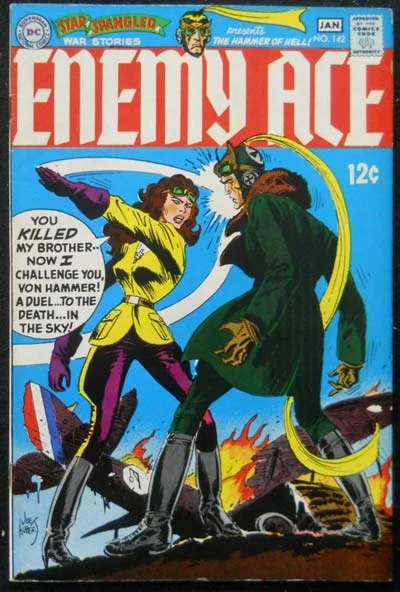
Star Spangled War Stories #142
January 1969
Widely considered by historians to be the single finest issue of the original Silver Age run
DC Graphic Novel #1
October 1990
A critically acclaimed, fully painted prestige graphic novel written and illustrated by George Pratt
Enemy Ace: War in Heaven #1
May 2001
The massive World War II transition written by Garth Ennis with artwork by Chris Weston and Russ Heath